From AirTurn to Audiobooks: How Hugh Sung Builds Tools That Solve His Own Problems
Hugh Sung has had arguments with an AI, and won them. He uses AI to help build software, and sometimes the machine insists, on the strength of everything it can measure, that it is right. “And then I sometimes have to go and argue like, ‘No, my ears tell me differently. Your data is not right.’” He has to find ways to prove the point, to bring evidence, until the machine concedes. “It’s been interesting to see the AI almost humble itself.”
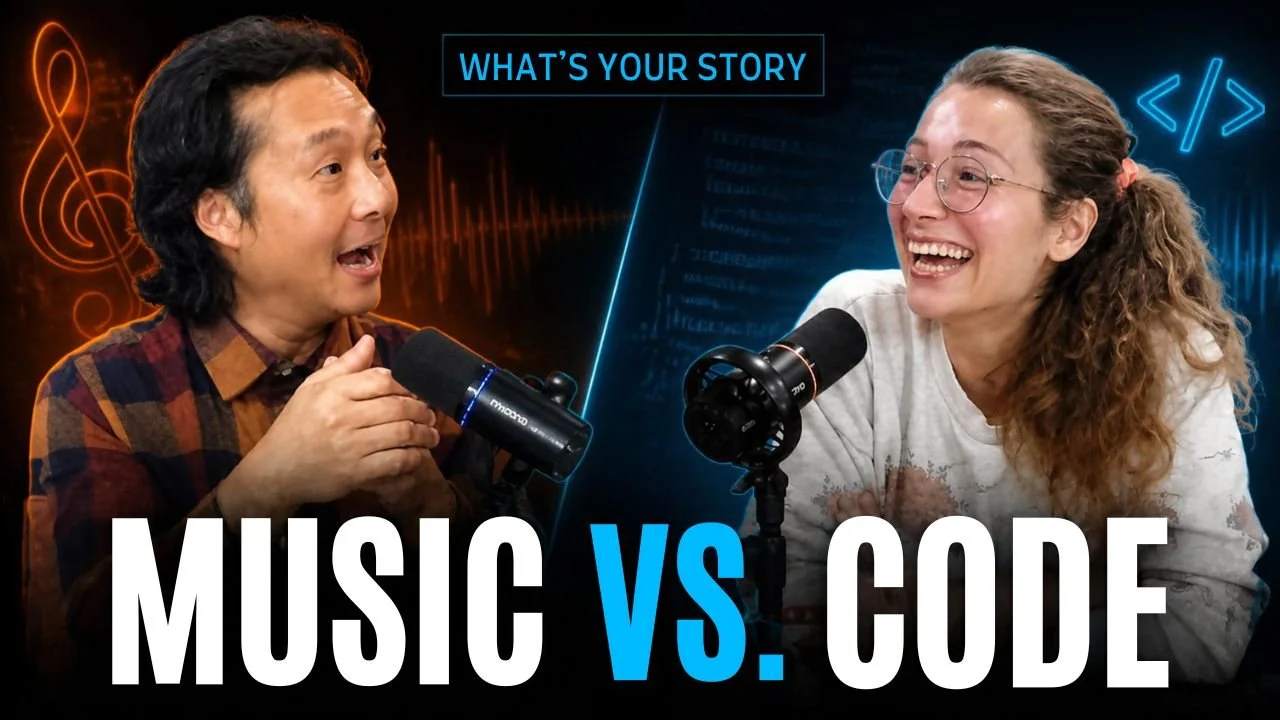
It is a telling image for a man who has spent his life with one foot in the practice room and the other in the workshop. Sung entered the Curtis Institute in Philadelphia at 13, invented AirTurn, the first hands-free page-turning pedal for musicians, taught a couple of thousand students around the world online through ArtistWorks, and is now vice president of Cunningham Piano Company, one of the oldest piano stores in America. He is also one half of a four-hands piano duo with Madalina Danila, the Romanian-American pianist who invited him to be the guinea pig for the first episode of her new conversation show, What’s Your Story, recorded at their dining-room table.
Ears versus data
Sung calls AI “an incredible collaborator,” but he is precise about where the line falls. “AI is fantastic at executing, but I still have to come up with an original idea.” And beyond ideas: “I still have to bring my humanness and my imagination and my judgment.” Left to itself, he says, the machine builds hoops nobody needs to jump through, and someone has to step back and say it doesn’t make sense to do it that way, simplify this, make that prettier — “all these things that a machine wouldn’t think about.”
His newest project is an audiobook production app, and it started, like AirTurn, with a problem of his own. A composer friend asked him to record some piano works and mentioned in passing that he was finishing a memoir. Sung offered to turn it into an audiobook, then realised what he had committed to. Editing a three- or ten-minute piece of music is already a lot of cutting. “Audiobooks easily are two, three, five, or even more hours in length. Can you imagine all the little cuts that you have to make and keep track of?” So he built an editor that does it for him: you read, press Enter when you stumble, read the line again, then let the software analyse the recording against the manuscript and stitch the best takes together. Several books made this way are already on Audible.
Could he have built it without AI? Technically, yes. What usually stops people, he argues, is the difficulty: the time, the hires, the circuitry and coding they would have to learn first. Take those barriers away and you are left asking “What if I could do this?” — and “it becomes more visionary.”
From Pythagoras to the concert grand
Danila put the question bluntly: what do technology and music have in common, for God’s sake? Sung’s answer was “Everything,” and he went back to the beginning to prove it. Pythagoras halved a string and found the octave; ratios produced intervals, and intervals added up to the twelve-tone alphabet Western music still uses. Bartolomeo Cristofori’s piano was less an invention than an evolution of the harpsichord, itself descended from instruments like the Romanian țambal, a feat of mechanical precision built so a string could be struck and its volume controlled. Today, he notes, Yamaha spent almost 20 years and a team of about 40 engineers redesigning its concert grand from scratch.
The relationship runs both ways. “The technology can help amplify our voice as a musician. The music can amplify the aspiration of the engineer, to not just build something functional, but transcend the physics to be something beautiful.” Which raises a question he clearly enjoys: “How do you define beauty to an engineer? What are the parameters for the perfect tone?”
The cost of convenience
For all his enthusiasm, Sung is wary of how much easier things are becoming. He had just watched a clip of Sylvester Stallone holding the old, thinly padded boxing gloves from the Rocky films and talking about the fight to get his scripts written and funded. “When art becomes easy, when there’s no struggle to your imagination, it’s just like a muscle. It gets stunted.”
His own proof was domestic. For a long time he relied on boxed meal kits: no shopping, no menu, everything pre-portioned. Then he got busy, the bags piled up and went bad in the fridge, and the food became a source of stress. He cancelled. The first weeks were a pain, but then something returned. “My imagination for dishes has come back.” Danila, who almost never follows a recipe to the letter, had the opposite experience — for her, the box of ingredients was the inspiration. Sung’s conclusion leaves room for both: use the conveniences, but be careful “that those conveniences don’t completely stifle our creativity.”
He hears the same tension on the shop floor, where parents shopping for a first piano worry about spending money on a child who might quit. His reply is that the point was never to make a musician. It is “to become a human being that understands the value of time, the value of imagination, the value of reflection, practice, frustration, failure, mastery.” If there is an antidote to AI, he says, it is something like learning the piano, or painting, or cooking from scratch, or running a marathon: “It’s not something that’s answered in a single prompt.” Danila tied this to Zena Hitt’s book Lost in Thought, which argues that anyone, whatever their job, can lead an intellectual life — provided their leisure stirs something deeper than flipping channels.
Two pianists, one keyboard
The duo nearly didn’t happen. Danila admitted her first impression was that they had started on the wrong foot. Sung agreed at once: “I totally had those feelings that I thought this is not going to work. We fought too much. We were just too different.” And now? “It’s never easy working with you.” “Ditto,” she replied.
As a collaborative pianist Sung is used to quick engagements where his job is to make things easy for the soloist. A committed duo is different; you have to go deep, with all the risks of a marriage. Sharing one instrument makes it harder still. Danila called it “the most dangerous path you can take,” because it is “like mirroring yourself”: decades of conviction about how a passage should go, and here comes another pianist doing it differently. Their first rule is to accept that they both have egos. “It’s important not to stifle each other’s ego,” Sung said, and then to work out how much to give way and how much to fight “for something that’s greater than what we bring individually.”
Danila borrows her method from Alan Rickman, who said the only real advice for actors is to listen to the other person as if you had never heard the line before. Sung brings a businessman’s eye: presenters who have heard plenty of solo pianists light up at the idea of four hands. Their arrangement of a Romanian folk suite, from Danila’s own region, has gone over in the United States and in Korea alike.
No such thing as retirement
Sung doesn’t fear birthdays and says his brain has never felt younger. When a friend told him he never wanted Sung to retire, he shot back: “I never want to retire. I don’t even know what the word means.” He calls the idea of working to a point and then letting life happen passively “one of the biggest dangers.”
There is still an unfinished dream. As a boy he wanted to be an animator. He built a drawing rig from three-hole-punch paper and cut-down pencils standing in for registration pegs on a light box, then spent weeks drawing a figure jumping, frame by frame, to film on a Super 8 camera. Danila recently saw a painting he made as a child of his family’s living room at Christmas and confessed to feeling “almost rage” that he stopped. He hopes to animate something one day, perhaps in Blender, the old-fashioned way.
Danila closed the pilot with the idea behind her show: every person has a story to share, and you just have to listen. Watch the full conversation to hear Hugh Sung tell his.